
How to Search the Howard Court Docket
Howard publishes no online municipal docket search. The official Howard Municipal Court process puts the city clerk at the front of the ticket path instead. Before you call, gather the ticket itself. Also collect the name on it, the issuing agency, and the written appearance date. Those details let the clerk tell a Howard ordinance case apart from a state case. The state kind gets filed with the Elk County District Court.
- Read the ticket for the named court and appearance date.
- For a Howard city matter, call City Hall at 620-374-2202 and ask for the municipal case number, current setting, and copy method.
- If the charge is under state law, search Kansas CaseSearch with Court set to District and County set to Elk County.
- Review the charge, events, status, and latest setting without assuming a payment entry ends the case.
- Confirm any appearance with the custodian before travel.
A state search that comes up empty does not disprove a Howard municipal case. It may simply mean the register sits with the city clerk rather than the district clerk.
Howard Ticket Handoff Starts the Docket
Under the city process, an officer hands the ticket and supporting information to the Howard city clerk. The clerk then gets the matter ready for the judge and city attorney. That handoff is the first real checkpoint in the local docket. It also explains why a fresh citation may not show up in a state portal, and why the city office is the best place to ask for its assigned case number. For official contact, the Howard City Hall page, wait, keep href exact: Howard City Hall page gives the civic route. That office is not the Elk County Clerk of the District Court. Joanna Hunter is the published city clerk contact for Howard municipal records. Erin Meador handles district-court records instead. The city page itself shows the office context that governs how a Howard docket gets routed.
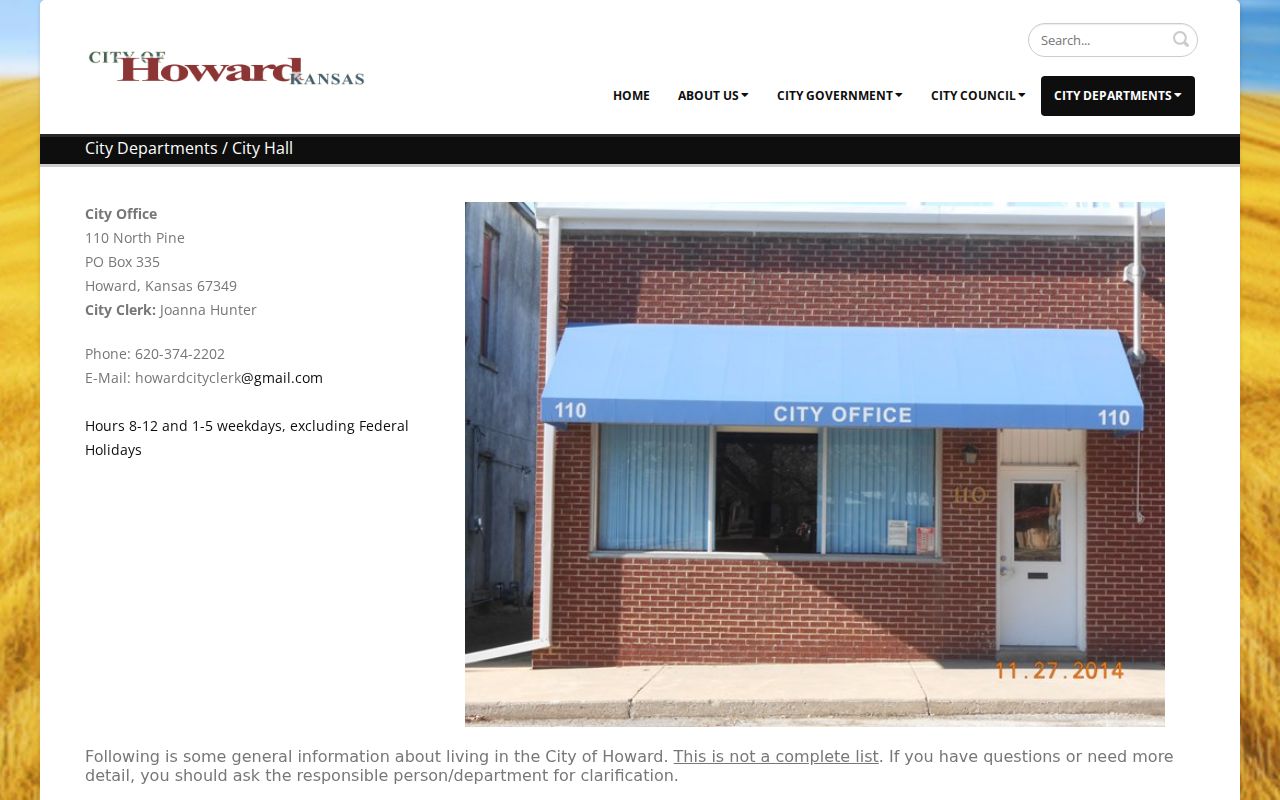
It backs the city-office contact path, not any claim of an online case index.
The Howard Municipal Court
Howard Municipal Court handles alleged violations of Howard ordinances. Under K.S.A. 12-4104, its jurisdiction centers on city-ordinance violations. It is not a lower arm of Elk County District Court. A city traffic notice stays in Howard Municipal Court. A state-law traffic citation gets filed in district court. The split changes who keeps the docket and where you appear. It also changes how you pay and how you order copies. The city clerk can explain how Howard indexed the municipal matter. The district clerk answers for state criminal, traffic, civil, family, probate, juvenile, and magistrate cases. The official Howard process governs first appearances, listed fines, and contested settings.
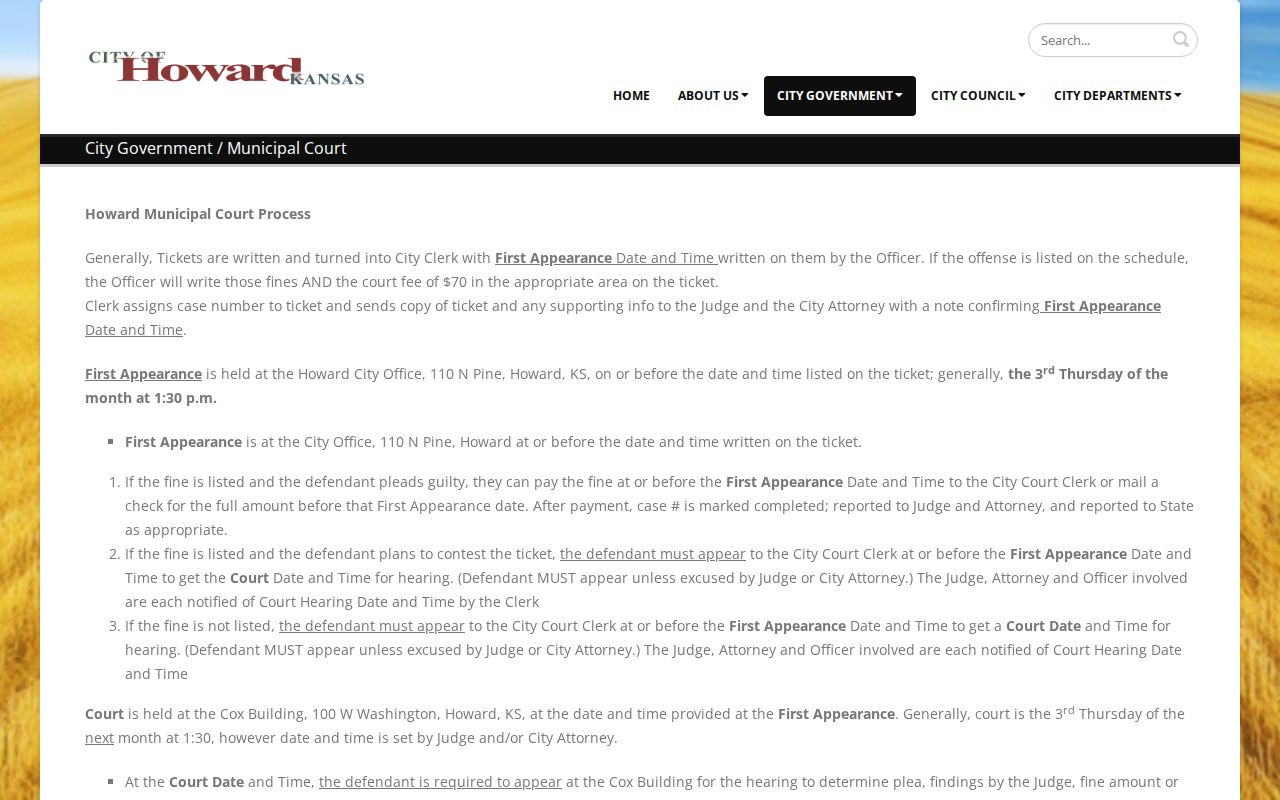
The court's own schedule is the go-to source for Howard first appearances, fine amounts, and contested hearing dates.
Howard First Appearance Has Two Controls
Howard schedules first appearances generally on the third Thursday at 1:30 p.m. But the officer writes the real date and time on the ticket. That printed notice controls your matter. A general schedule never lets you swap in a different date.
Key point: Appear at the Howard City Office, 110 N. Pine, on or before the date stated on the ticket, unless the court gives a different instruction.
If the city page and the ticket disagree, call the Howard clerk. Staff can read the case number, date, time, and hearing location back to you. Trust that word over a stale image or an undated docket search result.
Howard Court Dates and Settings
A Howard municipal setting can start with the ticket date and later shift to a contested-hearing date set by the judge or city attorney. Treat each field as its own instruction. A date alone tells you neither the venue nor the purpose of the appearance.
| Date | The date written on the ticket or later notice. |
|---|---|
| Time | The stated appearance time, not merely the general third-Thursday schedule. |
| Location | City Office for the initial route; Cox Building when the official contested-hearing instruction applies. |
| Setting Type | First appearance, plea, contested hearing, or another event set by the court. |
| Status | Pending, continued, resolved, or another status confirmed by the clerk. |
A continuance means the setting moved. It does not mean dismissal. Keep the newest written notice and confirm any changed Howard court date yourself.
Howard Contested Hearings Use Cox Building
For contested matters, the Howard municipal page names the Cox Building at 100 W. Washington, entered through the east room. That address is not the Howard City Office at 110 N. Pine, nor the Elk County Courthouse at 127 N. Pine. Three nearby addresses serve three different court-access jobs.
- 110 N. Pine is the published Howard City Office first-appearance route.
- 100 W. Washington is the published Cox Building contested-hearing location.
- 127 N. Pine houses Elk County District Court on the second floor.
Always confirm the place printed on the current notice. Never infer a civic address from a polling location or a county directory entry.
Howard Traffic Tickets
A Howard ticket may list a fine plus a $70 court fee. That wording comes from the local source, not a promise you can pay without appearing. Read the charge and instructions first. The city process allows a guilty or no-contest plea with payment when the listed-fine route applies; a contested case goes through the judge and city attorney.
- Listed fine
- An amount printed for an offense eligible for that route.
- Court fee
- The Howard page references a $70 fee alongside a listed fine.
- No contest
- A plea that does not contest the charge; the court still enters a result.
- Contested hearing
- A setting at which the charge is disputed before the municipal court.
A state-law citation follows the district-court route described in Elk County traffic court records. Confirm the named court and amount before sending any payment.
Howard Municipal Rows Show Modest Activity
The official municipal reports show 23 Howard filings for FY2022 and 13 for FY2023. Those are aggregate report figures. They hold no private case detail, and they should not be added to Elk District Court traffic totals, since the two systems keep separate jurisdiction and reporting.
The Kansas case-statistics index places such numbers in their official reporting context.
The totals show reported activity, not the status of any individual Howard case.
Where Howard Cases End Up
Most state cases leave town. Felonies, Kansas misdemeanors, state traffic charges, civil suits, family matters, probate, juvenile matters, and other state cases go to Elk County District Court even when the event arose in Howard. Kansas CaseSearch handles the statewide public side of eligible district records. A terminal at the courthouse may also show public detail that remote access does not.
Docket flow: Howard Municipal Court › Elk County Courts › Kansas District Court, Elk County District Court, 13th Judicial District
Call the Elk district clerk at 620-374-2370. In-person review of public files runs by appointment. The 13th District page says the case number is required. For the county-wide view, use the Elk County court docket overview.
Howard Search Gaps Need Clerk Checks
Howard posts no online docket form. Treat that gap as a routing problem. Skip the unofficial people-search sites. Start with the city clerk for municipal records. If staff spots a state case, move to Kansas CaseSearch or the district clerk. When remote detail runs thin, ask about the courthouse terminal or a written request. Kansas Rule 22 separates remote electronic access from terminal access. Some public data shows only at the courthouse, and sealed or rule-excluded material stays off-limits, so a blank screen can reflect jurisdiction, access level, spelling, timing, or restriction rather than any outcome.
Public Access to Howard Court Records
Howard municipal records come from the city custodian. District records come from the Elk County Clerk of the District Court. Say what you want. A good request names the record, gives the case or citation number if known, states whether you want inspection or copies, and includes a date range. Staff may ask for a written request when that helps identify the record.
Key rules:
Kansas Open Records Act, K.S.A. 45-215 states Kansas public-access policy.
Kansas eCourt Rule 22 controls remote and courthouse-terminal access to district and appellate records.
Kansas eCourt Rule 24 requires protected personal identifiers to be kept from public filings.
Asking does not unlock everything. Sealed files, juvenile information, protected identifiers, and other exempt material stay closed no matter who requests them. When an open record contains closed material, the custodian applies the governing separation and access rules.
Howard Docket Entries Need Context
Howard's county-seat status creates its own trap. The official county history dates the seat to 1875. That year is not a construction date for the courthouse. It proves nothing about any docket book's age either. City Hall, the Cox Building, and the county courthouse remain three distinct destinations. Match the court name on your paper first.
A Howard ticket dated off the third-Thursday schedule needs a call. Preserve the ticket. Contact Joanna Hunter's office. Ask whether the case still sits at first appearance, landed on a contested docket, or drew a later order. If it became a district matter, get the district case number before using CaseSearch. That habit keeps a city schedule from overriding a case-specific notice.
A register of action is an event index. The full file is not there. A Howard docket entry may name a filing, setting, order, plea, payment, continuance, or disposition while the underlying papers stay with the custodian. Read the event date, filing label, party role, judicial officer, and status together. A payment line does not settle every duty. A setting line is not proof a trial happened. If the meaning affects an appearance, get the filed notice or order and confirm with the Howard clerk.
Kansas Rule 106B names this index for district cases: the register of action. Remote CaseSearch offers public case information. A courthouse terminal can add eligible detail. Howard municipal court records have no equal online index. The city clerk can explain what event record exists and how to receive it.