
The Elk County Court Calendar
Elk County is part of Kansas's 13th Judicial District with Butler and Greenwood Counties. Its public Main Calendar is a district website calendar, while Kansas CaseSearch carries case information and register events. These tools overlap, but they are not the same record. A broad calendar item may lack the detail found in a case, and a case setting may not appear as a stand-alone public calendar event. The court order and current register control.
Most Elk district matters are handled within the unified Kansas District Court. City ordinance settings are kept by each municipal court. Read the court name on the notice before choosing a calendar.
Elk Calendar Date Controls
The 13th Main Calendar offers start-date and end-date fields, a search box, past-event control, and list, week, or month views. Print, Notify Me, and iCalendar are convenience tools. They do not amend an order.
See the controls at the official source.
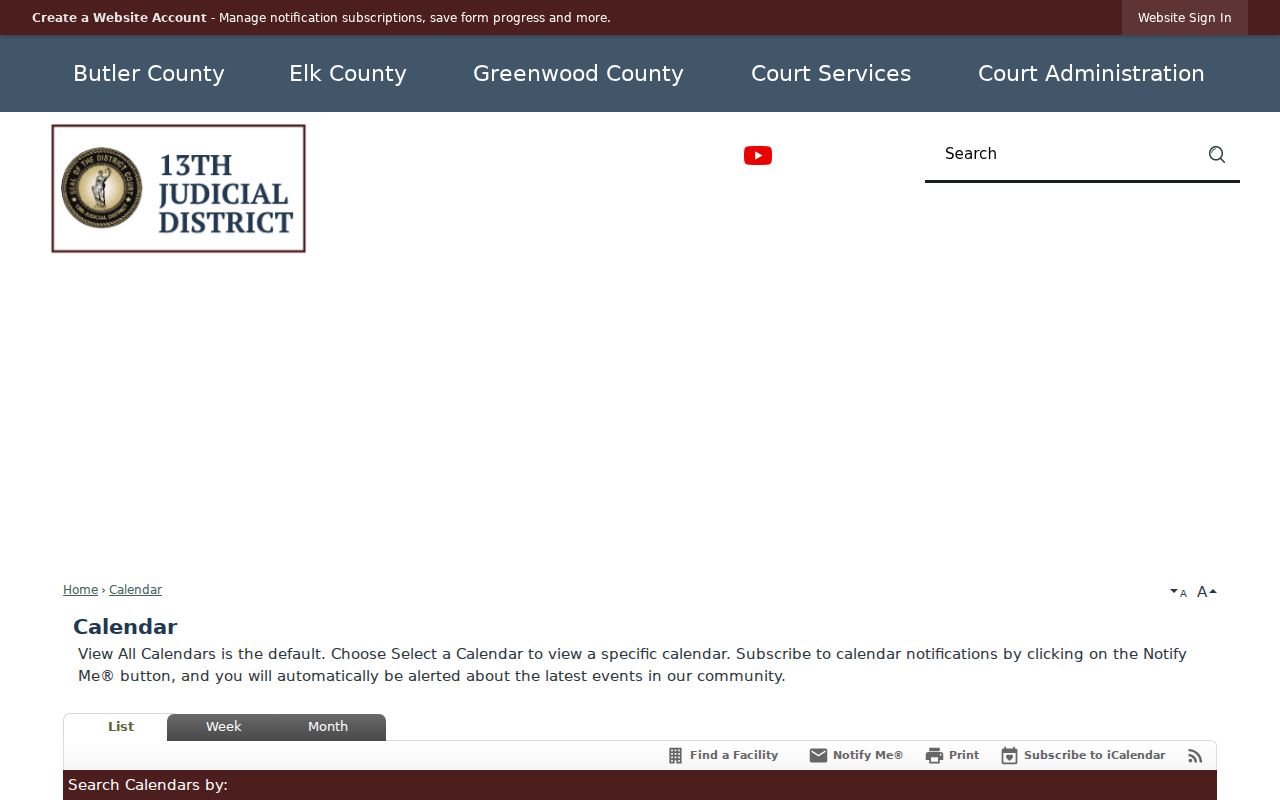
The image identifies the filters, but a searcher should still open the case and confirm changes with the clerk.
How to Find Your Court Date
Use the case number when possible. Kansas CaseSearch supports district searches, with Elk County as a filter. A name can work, but common names make results hard to match. Modern Elk numbers begin with EL. Older cases may use the earlier form without it.
- Open Kansas CaseSearch and select District.
- Search by case number or name and choose Elk County.
- Read the newest setting, status, and replacement date.
- Compare it with the written order and district calendar.
- Call the clerk at 620-374-2370 if unclear.
Blank Elk Calendars Can Mislead
A blank calendar does not prove there are no Elk County hearings. Filters may exclude the date, or the event may appear only within CaseSearch. Some public details are available only on a courthouse terminal. If online access fails, use the public computer at 127 N. Pine in Howard or make an appointment for an open file.
Use an access ladder. Check the case, review the calendar, then call the Elk clerk or use the public terminal.
Do not infer dismissal from a missing entry. Only a filed order or confirmed event establishes what happened.
Search controls can create a false blank result. The Main Calendar has separate start and end dates, a search-term field, a calendar selector, and an option for past events. Clear a narrow term, expand the date range, and check whether past items are hidden. Then compare that broad calendar view with the case-specific setting block in CaseSearch. A general calendar event and a register event can be published through different workflows.
The public portal also offers District and Appellate search paths. Choose District for an Elk County trial matter. A municipal ordinance case will not become an Elk district case merely because the city lies within the county, and a federal date belongs in District of Kansas CM/ECF rather than the 13th District calendar. The court named on the notice determines which system to search.
Reading a Court Setting
A setting is a scheduled event, not necessarily a trial. Match it to the case number and court, then read the fields together. A later entry may replace an earlier one.
| Date | The scheduled day, subject to a later order. |
|---|---|
| Time | The start or docket-call time. |
| Court | District, magistrate, or city court. |
| Judge | The assigned judicial officer. |
| Setting Type | Arraignment, pretrial, hearing, or trial. |
| Status | Scheduled, reset, cancelled, or completed. |
Elk Setting Status Terms
Continued means the court moved the matter without finishing it. Reset points to a new setting. Cancelled means the event will not occur as shown, but it does not end the case. Completed describes the event, not necessarily the case.
- Register of action
- The case events index.
- Setting
- A scheduled court event.
- Disposition
- A recorded result.
Read each term beside the newest order. If no replacement date appears, contact the clerk.
Resets, Continuances, and Cancellations
A continuance must come from the court. A call, calendar subscription, or payment does not move a hearing. The register may show the old event, changed status, later event, and filed order. Read all of them.
CaseSearch and the calendar may update at different times. Confirm same-day changes with the clerk or counsel. The Elk counter closes Thursdays from 1:30 to 2:30 p.m. for a staff meeting.
Elk Reminders Are Not Orders
Kansas offers a hearing reminder service, and the calendar has subscription tools. Both help track dates. Neither changes the case. A delayed message or stale feed does not excuse reliance on an old date.
Keep the notice, note the case number, and recheck the register. Confirm municipal matters with the relevant city clerk.
Print, Notify Me, and iCalendar can preserve or transmit what the district calendar displayed at one moment. They do not guarantee that a later reset will reach every device. A subscription may also cover the chosen district calendar rather than every event within one case. Treat an alert as a prompt to verify, not as proof that no other setting exists.
Reminder enrollment remains separate from the register of action. The current event status and any filed scheduling order carry more weight. If two sources conflict, save the case number and call the Elk clerk at 620-374-2370. A represented party should contact counsel too, since court staff cannot interpret an order or advise whether an appearance can be skipped.
Elk Court Dates Across Systems
Elk County has more than one court-date stream in a small area. The District Court Clerk keeps the state district-court register for criminal, civil, traffic, family, probate, juvenile, and magistrate matters. Each municipal clerk keeps the city's ordinance and municipal-traffic cases. The general Elk County Clerk handles county government records and is not the state-court docket keeper. A person who calls the wrong office may receive a correct answer that the office has no record, even though another court holds the case.
Start with the paper that created the duty to appear. A citation, summons, notice, or order should identify the court. State-law traffic cases generally route to district court in the county of the alleged offense. City ordinance cases route to the named municipal court. Howard publishes the clearest city routine: the ticket goes to the city clerk with a first-appearance date, while a contested matter can later receive a hearing set by the judge and city attorney. That city process should not be folded into the 13th District calendar.
The online tools also divide by purpose. CaseSearch is the public case-information and events system. The 13th Main Calendar is a broad district calendar. The Kansas Courts Central Payment Center searches payment obligations, not the authoritative register of action. eFlex is for authorized filing, not public viewing. Finding a balance in the payment system does not prove the present hearing date, disposition, or warrant status. A filer seeing a submission in eFlex should likewise wait for accepted case information rather than treating submission as a public calendar event.
When a date cannot be found online, the courthouse terminal is the strongest public fallback. Kansas Rule 22 creates a real distinction between internet access and terminal access. Some information or documents that do not display through the web may still be available at the courthouse. Other categories remain restricted. An appointment to inspect an open file requires the case number, and the clerk uses a designated review room. Write down the number before visiting.
A written records request can locate an event record or order when ordinary searching does not answer the question. Identify the case number, the specific record sought, and whether inspection or a copy is needed. Requests may be mailed to P.O. Box 306, Howard, KS 67349-0306, faxed to 620-374-3531, or sent through the official district form route. The clerk has a three-business-day response framework, but that is not a promise that every record will be produced within three days. A delay or denial should be explained under the applicable Kansas process.
Same-day uncertainty calls for direct confirmation. Call 620-374-2370 during the published counter hours, state the case number, and ask which public source carries the current event. If represented, contact counsel too. Do not place a filing or payment in the courthouse drop box and assume it changed the calendar. Staff retrieve the court box on weekday mornings, yet retrieval is not necessarily the file-stamp time or judicial approval of a requested continuance.
What To Do If You Miss a Setting
Act at once. Check the newest event, call the court, and speak with counsel if represented. Ask whether the judge entered a new setting or order. Staff can give procedure information, but not legal advice.
Missed a setting? A missed date may lead to a failure-to-appear entry, warrant, bond action, or other response.
Contact the Elk clerk or city court on the notice and confirm the status.
Legal advice should come from a Kansas lawyer.